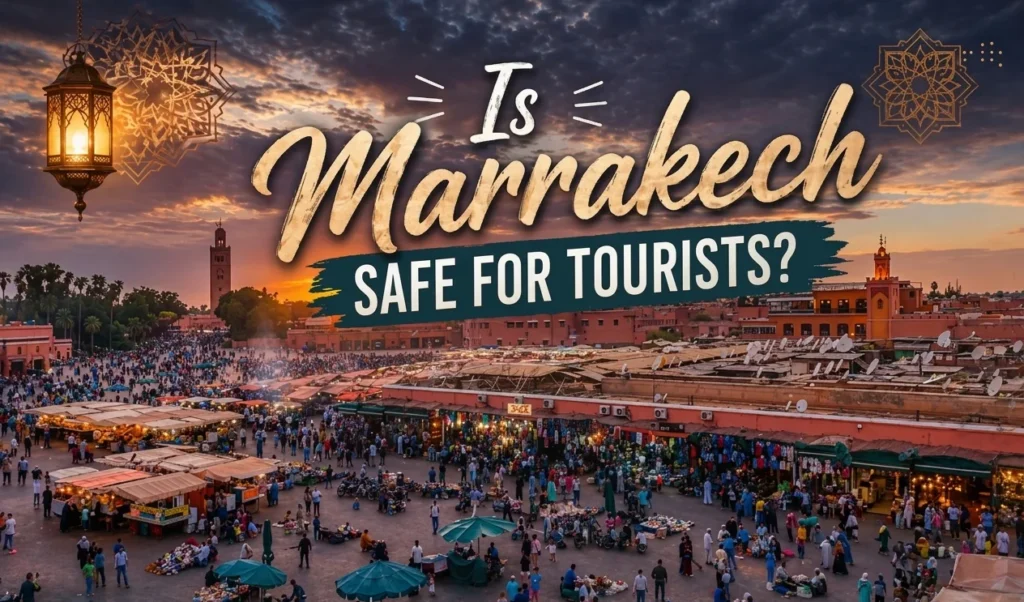
💡 Quick AnswerYes, Marrakech is safe for tourists in 2026. Morocco consistently ranks among the safest countries in North Africa according to the Global Peace Index, and Marrakech specifically benefits from a strong tourist police presence at major sites. Violent crime against tourists is rare. The most common issues are pickpocketing in crowded areas, fake guides, and minor scams all easily avoidable with basic awareness. |
Safety is the question I get asked more than any other by first-time visitors. It’s a fair question : and it deserves an honest answer, not a marketing pitch.
After more than a decade of guiding visitors from over 50 countries through Marrakech, I’ve seen exactly which situations actually pose risks and which are blown out of proportion online. This guide gives you the real picture : based on lived experience, not rumors : and the practical precautions that cover 95% of safety considerations for a normal trip.
Planning your trip? Start with our Ultimate Guide to Exploring Marrakech for the full city overview
How Safe Is Marrakech Compared to Other Tourist Destinations?
Marrakech ranks among the safest major tourist destinations in North Africa and is statistically safer than many European capitals for violent crime.
Morocco placed in the top 3 safest countries in Africa in the most recent Global Peace Index ranking, and tourism continues to grow steadily, over 17 million international visitors came to Morocco in 2024, with Marrakech as the #1 destination.
| Safety dimension | Marrakech reality |
|---|---|
| Violent crime against tourists | Very rare |
| Pickpocketing | Common in crowded areas (Jemaa el-Fna, souks) |
| Scams & overcharging | Common but easily avoidable |
| Terrorism risk | Low : same level as most European destinations |
| Political stability | High : Morocco is one of the most stable countries in the region |
| Tourist police presence | Strong at all major sites |
| Healthcare access | Good in private clinics in Gueliz |
What Are the Most Common Safety Issues in Marrakech?
Most safety concerns in Marrakech fall into five categories : none of them dramatic, all of them avoidable.
1. Pickpocketing in Crowded Areas
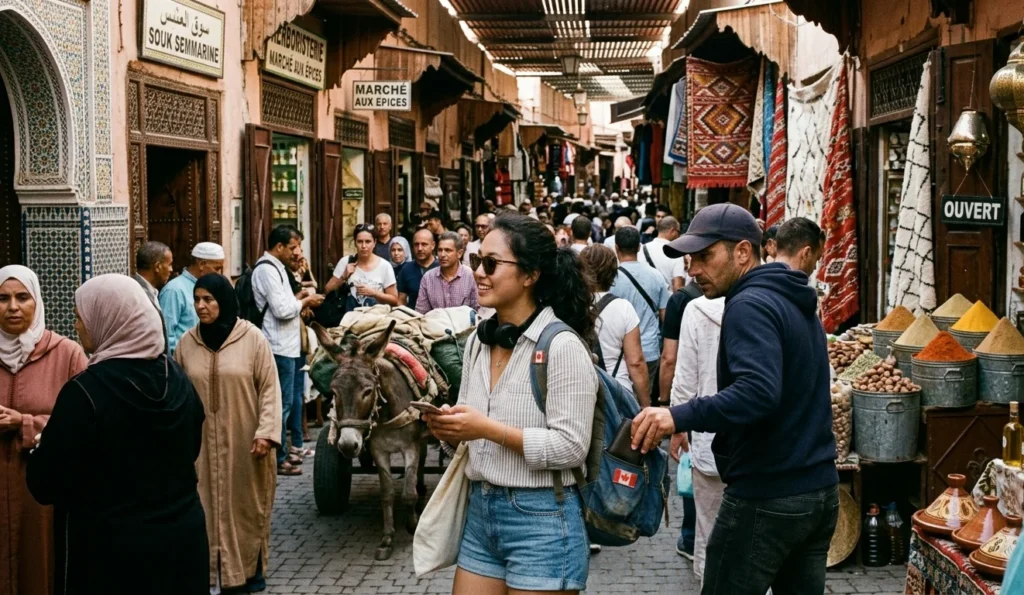
Pickpocketing is the #1 safety issue tourists face in Marrakech. It happens almost exclusively in crowded spots:
- Jemaa el-Fna at peak hours (after 7 PM)
- Souk Semmarine during midday rush
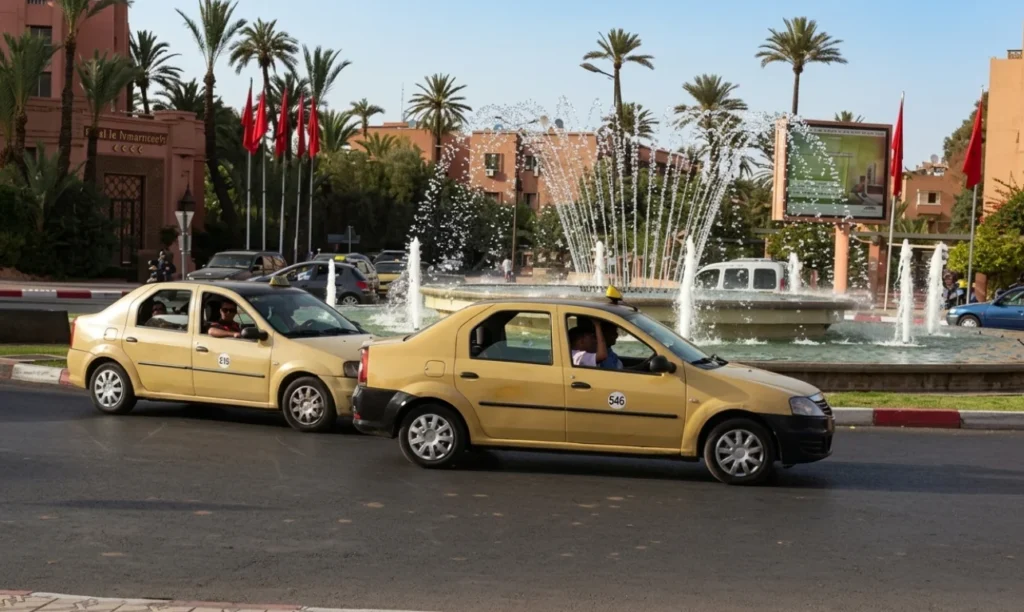
- Inside grand taxis (shared taxis)
- Around major monument entrances when tour groups arrive
How to prevent it:
- Carry a crossbody bag worn in front in crowded areas
- Keep your phone in a zipped inner pocket : never in a back pocket
- Carry only what you need for the day
- Leave passport and excess cash in your riad safe
2. Fake Guides
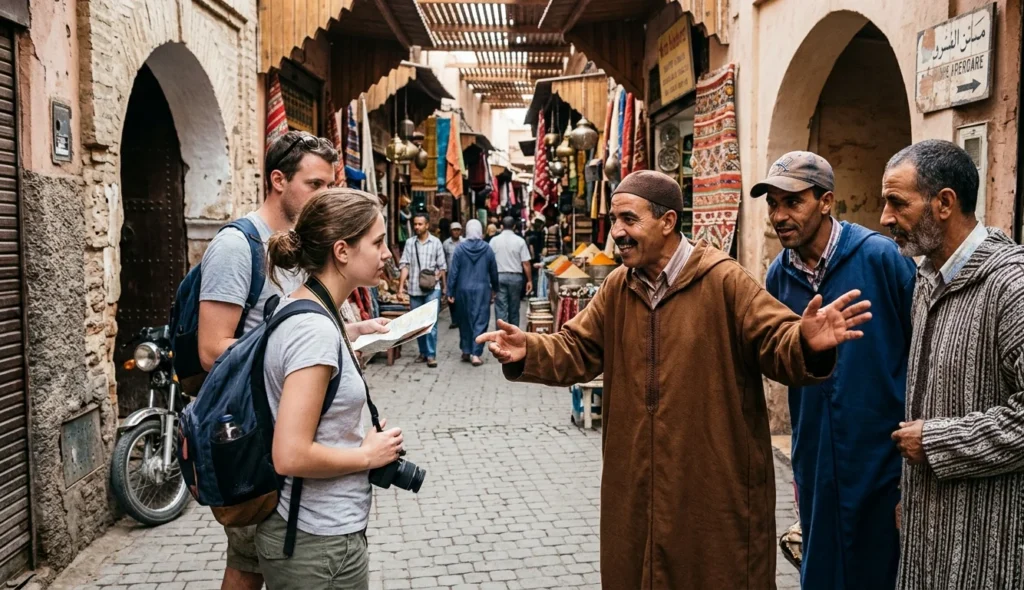
Fake “guides” are the most common scam in the Medina. They typically approach tourists with one of three openings:
- “This way is closed, follow me”
- “There’s a special Berber market today, come”
- “Your hotel is the other way, I’ll show you”
After leading you somewhere, they demand 100–500 MAD or pressure you into a shop where they receive a commission.
How to spot a real guide:
- Official ID badge with photo and license number (every legitimate Moroccan guide has one)
- Booked in advance through a reputable operator
- Will show credentials before you ask
- ❌ Approaches you on the street : real guides don’t need to
💡 Local Tip from Ayoub : If a stranger approaches you in the Medina with a “tip,” respond with “la, shukran” (no, thank you) and keep walking. Don’t engage. Politely declining once is enough. |
3. Taxi Overcharging
Initial prices in the souks are typically 3–4× the real value. This isn’t fraud : it’s the negotiation culture. The risk is paying tourist prices because you didn’t know the system.
How to prevent it:
- Visit the Ensemble Artisanal (Bab Nkob) first : fixed-price government cooperative
- Start at 30–40% of the asking price
- Settle around 50–60% of the asking price
- Walk away politely if needed : the price will often drop
4. Souk Pricing Scams
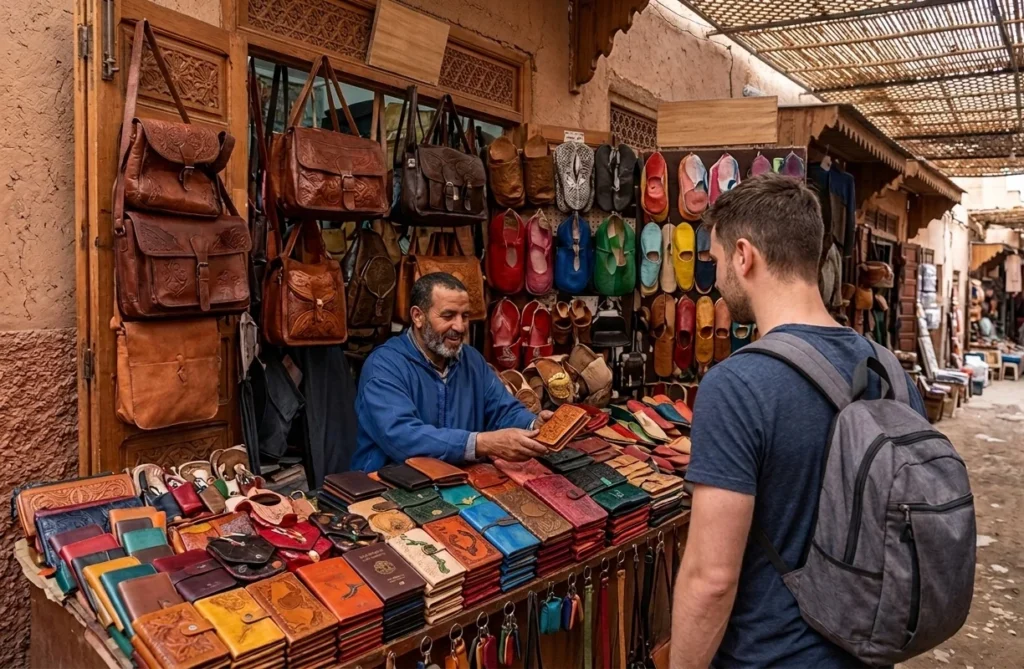
Initial prices in the souks are typically 3–4× the real value. This isn’t fraud : it’s the negotiation culture. The risk is paying tourist prices because you didn’t know the system.
How to prevent it:
- Visit the Ensemble Artisanal (Bab Nkob) first : fixed-price government cooperative
- Start at 30–40% of the asking price
- Settle around 50–60% of the asking price
- Walk away politely if needed : the price will often drop
Initial prices in the souks are typically 3–4× the real value. This isn’t fraud : it’s the negotiation culture. The risk is paying tourist prices because you didn’t know the system.
Before shopping, read our Marrakech Souks Shopping Guide to understand how the markets work, what to buy, and how to negotiate confidently.
5. Photography Disputes
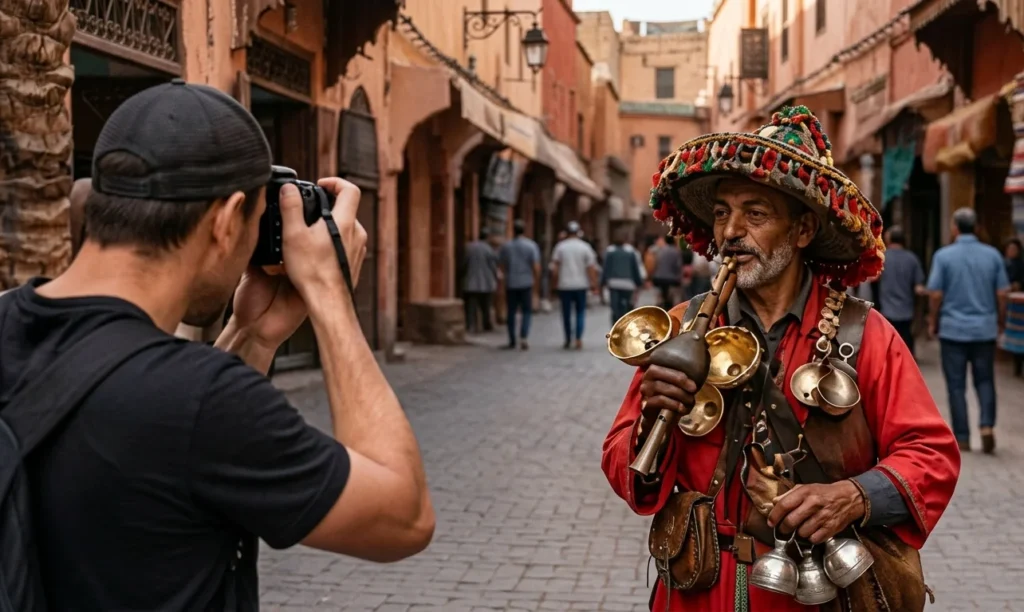
Photographing people without asking is a recurring source of friction : especially in Jemaa el-Fna with snake charmers, water sellers, and henna artists. They’ll pose freely, then demand 50–200 MAD per photo.
How to prevent it:
- Always ask before photographing a person
- Agree on a tip beforehand (10–30 MAD is fair)
- For henna, agree on the design AND the price before they start
Is Marrakech Safe for Solo Female Travelers?
Yes, Marrakech is safe for solo female travelers in 2026 : thousands visit every month without incident. That said, the experience is different from European destinations, and a few cultural realities are worth understanding.
What to expect:
- Verbal attention : comments, whistles, and “hellos” are common, especially in the souks. They’re rarely threatening but can feel persistent.
- Less attention with modest dress : covered shoulders and knees significantly reduce unwanted attention
- Restaurants and cafés are safe at all hours
- Hammams have separate hours/areas for women : fully appropriate
Practical recommendations:
| Tip | Why it matters |
|---|---|
| Wear a wedding ring (real or symbolic) | Reduces approaches noticeably |
| Avoid eye contact with strangers in the souks | Cultural norm : staring = invitation |
| Scams & overcharging | Common but easily avoidable |
| Terrorism risk | Low : same level as most European destinations |
| Political stability | High : Morocco is one of the most stable countries in the region |
| Tourist police presence | Strong at all major sites |
| Healthcare access | Good in private clinics in Gueliz |
💡 Local Tip from Ayoub : The most common complaint from solo female travelers isn’t safety : it’s persistence. Saying “la, shukran” firmly once and continuing to walk is more effective than trying to be polite or explain. Politeness can be misread as interest. |
Is Marrakech Safe at Night?
Yes, Marrakech is safe at night in well-traveled areas : Jemaa el-Fna is busy until midnight, the main Medina arteries are well-lit, and Gueliz/Hivernage are active until late.
Where it’s safe at night:
- Jemaa el-Fna : full of activity until ~11 PM
- Main Medina arteries (Riad Zitoun, Souk Semmarine) : open until 10 PM
- Gueliz boulevards : restaurants and cafés open until midnight
- Hivernage : hotel district, very safe
Where to avoid alone at night:
- Empty back alleys of the Medina after 9 PM
- The Mellah after dark (residential, very quiet)
- The outskirts of the palmeraie without transport
💡 Local Tip from Ayoub : If you’re walking from Jemaa el-Fna back to your riad after 10 PM, stick to the main streets even if it adds 10 minutes. The detour is worth the peace of mind. |
Are Health & Medical Risks a Concern?
Marrakech has good private healthcare in Gueliz, and standard travel precautions are sufficient for most visitors.
| Risk | Likelihood | Prevention |
|---|---|---|
| Stomach upset (traveler's diarrhea) | Common | Drink bottled water, eat at well-reviewed places |
| Sunburn / heatstroke | High in summer | Hat, sunscreen, water, avoid midday in summer |
| Hospital quality | Good in private clinics | Cliniques Internationales in Gueliz are recommended |
| Vaccination requirements | None mandatory | Routine vaccinations up to date |
| Tap water | Technically potable | Use bottled for drinking, fine for showering/teeth |
| Travel insurance | Strongly recommended | For private clinic care and evacuation |
Where Are the Safest Areas to Stay in Marrakech?

All major tourist neighborhoods in Marrakech are safe to stay in. The choice depends more on the type of experience you want than on safety differences.
| Neighborhood | Vibe | Safety | Best for |
|---|---|---|---|
| Medina (inside walls) | Authentic, historic | Safe with awareness | Riad lovers, first-time visitors |
| Hivernage | Modern, hotel district | Very safe | Families, comfort travelers |
| Gueliz | Contemporary, café culture | Very safe | Modern hotels, longer stays |
| Palmeraie | Resort area, calm | Very safe | Luxury, privacy |
| Mellah | Quiet, traditional | Safe by day, quiet at night | Budget options |
Recommended specific zones inside the Medina:
- Riad Zitoun el Kedim / el Jdid : central, well-trafficked
- Bab Doukkala area : gateway to the Medina, taxi access
- Mouassine quarter : beautiful riads, calm streets
What About Terrorism & Political Stability?
Morocco’s terrorism risk level is comparable to most European destinations, and the country is one of the most politically stable in the region.
The Moroccan government has invested heavily in security infrastructure since 2011, including:
- Visible police presence at all major tourist sites
- Coordinated tourist police units in Marrakech, Fes, and Casablanca
- Modern intelligence cooperation with EU partners
- Strong border management
Practical reality for tourists: you’ll see police regularly at Jemaa el-Fna, near monuments, and in Gueliz : visible but unobtrusive.
Is Marrakech Safe After Recent Earthquakes?
Yes. The September 2023 earthquake epicenter was in the Atlas Mountains, not Marrakech itself.
While the historic Medina sustained minor damage to a few structures, the major sites (Bahia Palace, Jardin Majorelle, Jemaa el-Fna, Koutoubia, the souks) are fully open and operating normally in 2026.
The Moroccan government has completed extensive restoration work on heritage sites, and tourism infrastructure has fully recovered.
Visiting Marrakech in 2026 also directly supports the local recovery economy : particularly in the surrounding Atlas villages where many tour itineraries pass through.
Practical Safety Checklist Before You Go
Before your trip, run through this short checklist:
- [ ] Travel insurance with medical evacuation coverage
- [ ] Photocopy of passport stored separately from the original
- [ ] Cash in two locations : never all in one wallet
- [ ] Trusted accommodation booked in advance (Booking.com, direct riad)
- [ ] Emergency numbers saved: 19 (Police), 15 (Ambulance/SAMU), 150 (Tourist Police)
- [ ] Travel registration with your embassy (optional but recommended)
- [ ] Modest clothing packed (shoulders + knees covered)
- [ ] Licensed guide booked for Day 1 in the Medina
- [ ] Bottled water plan for the trip
How a Licensed Guide Reduces Safety Concerns Dramatically
After a decade of guiding visitors, here’s the simple truth: a licensed guide on Day 1 eliminates 90% of the safety friction first-timers experience.
Here’s why:
- No fake guides : they don’t approach travelers who are with a guide
- No taxi overcharging : pickup and drop-off are coordinated at fair prices
- No scams in the souks : your guide knows the cooperative shops and fair pricing
- Cultural awareness : what to do, what not to do, what to wear
- No getting lost : the 9,000-alley Medina becomes navigable
What to look for in a guide:
- National license (every legitimate Moroccan guide has an ID badge)
- 100% private tours : no group mixing
- Verified reviews on TripAdvisor or Google
Conclusion
Marrakech in 2026 is safe, welcoming, and accessible to travelers from around the world. The vast majority of visitors leave with stories of warm hospitality and unforgettable experiences : not safety incidents.
The handful of issues that do exist (pickpocketing, fake guides, taxi overcharging) are real but minor, and a few simple precautions handle them. Travel with reasonable awareness, dress respectfully of local culture, book a licensed guide for your first day, and you’ll experience Marrakech the way it deserves to be experienced.
The city has been welcoming travelers from every continent for nearly 1,000 years. There’s a reason for that.:
Frequently Asked Questions
Yes, in well-traveled areas. Jemaa el-Fna, the main Medina arteries, Gueliz, and Hivernage are all safe until late. Avoid empty Medina back alleys alone after 9 PM, and use a taxi for longer night trips.
Avoid: photographing people without permission, accepting unsolicited “guide” services, walking empty alleys at night, paying without negotiating in souks, and drinking tap water for drinking purposes.
Yes. The earthquake epicenter was in the Atlas Mountains, not Marrakech. Major sites are fully open, restoration of heritage sites is complete, and tourism has fully recovered. Visiting in 2026 directly supports local recovery.
- Police: 19
- Ambulance/SAMU: 15
- Tourist Police: 150
- Fire: 15
All major tourist neighborhoods are safe. Hivernage and Gueliz are the calmest and most modern. The Medina is safe with awareness : choose central zones like Riad Zitoun, Bab Doukkala, or the Mouassine quarter.