💡 Quick AnswerMarrakech Medina is the UNESCO-listed old walled city, founded in 1062 and home to one of the world’s largest traditional markets.
|
What Is the Marrakech Medina? A Quick Orientation
The word medina simply means “city” in Arabic. In Marrakech, it refers to the old walled city a UNESCO World Heritage Site since 1985 that predates the French-built Ville Nouvelle by nearly nine centuries.
The basics:
- Built around 1062 by the Almoravid dynasty
- Enclosed by 19 km of ramparts, mostly intact to this day
- Home to approximately 200,000 residents, roughly a fifth of Marrakech’s population
- Contains 9,000+ alleyways, the largest traditional souk in Morocco, and dozens of historic monuments
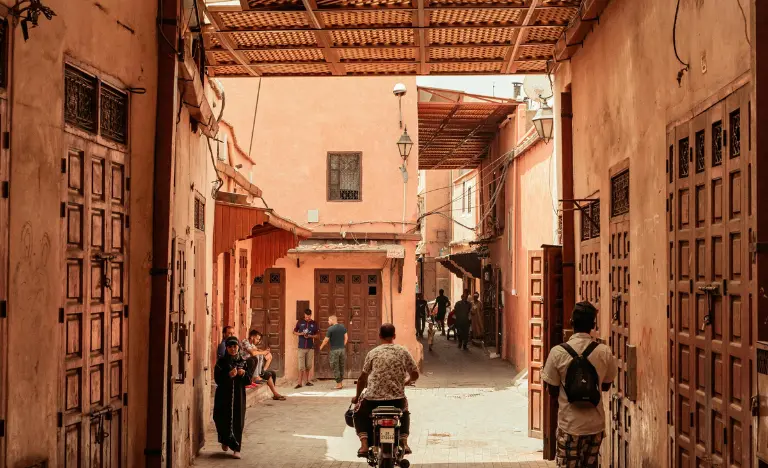
From above, the Medina looks like a human honeycomb. At street level, it feels like a maze of sensory overload, and a deeply human place once you find your footing.
The four main areas to know:
| Area | What it's known for |
|---|---|
| Jemaa el-Fna & surroundings | The central square, street food, entertainers, tourist activity |
| The Souks | Craftsmen, merchants, spices, leather, textiles, organized by trade |
| Mouassine & Bab Doukkala | Quieter residential streets, hidden riads, local life |
| Mellah (Jewish Quarter) | Historic Jewish heritage, covered market, spice traders |
The Medina is compact enough to walk, but dense enough that a private guided Marrakech Medina Tour can completely transform what you see and understand in just a few hours.
Local tip: Most visitors spend 90% of their time in the northern tourist quarter around Jemaa el-Fna. The real Medina, quieter, more residential, more authentic, starts the moment you walk south past the main souks. |
Top Things to See and Do in the Marrakech Medina
1- Jemaa el-Fna Square
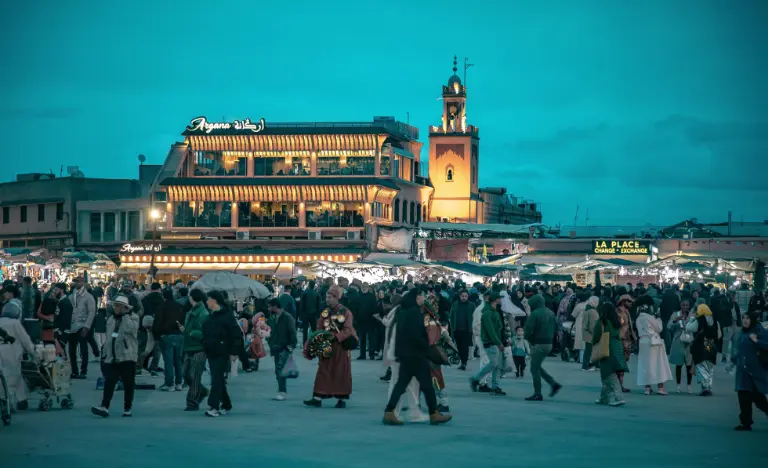
The Medina’s beating heart is Jemaa el-Fna, a name that roughly translates as “Assembly of the Dead,” a nod to its historic use as a site for public executions. Today, it pulses with life from sunrise to midnight.
Come in the morning for a quiet cup of freshly squeezed orange juice a standard glass (3–5 MAD) and a front-row seat to the waking city.
Come at night for something else entirely: the square transforms into an open-air theatre of storytellers, Gnawa musicians, acrobats, henna artists, and dozens of smoke-filled food stalls. It’s chaotic, loud, and absolutely unmissable.
For everything you need to know about the square, the history, the best time to visit, and what to watch out for read our dedicated guide to Jemaa el-Fna Square
2- The Souks
The souks of Marrakech are among the most famous and vibrant traditional markets in Morocco. What looks like random chaos is actually organized by trade,a system that has remained largely unchanged for nearly a thousand years. Each craft has its own dedicated quarter, its own sounds, its own smells.
How the souks are organized:
- Souk Semmarine — the main artery: textiles, clothing, souvenirs
- Souk el-Attarine — spices, argan oil, rose water
- Souk Chouari — woodworkers and carpenters
- Souk Cherratine — leather goods
- Souk Haddadine — blacksmiths, the sound of hammering fills the air
The key to enjoying the souks is to walk without urgency. Eye contact signals interest; a slow, unbothered pace signals you’re browsing. If someone follows you, a polite “la shukran” (no thank you) is all you need.

3- Bahia Palace
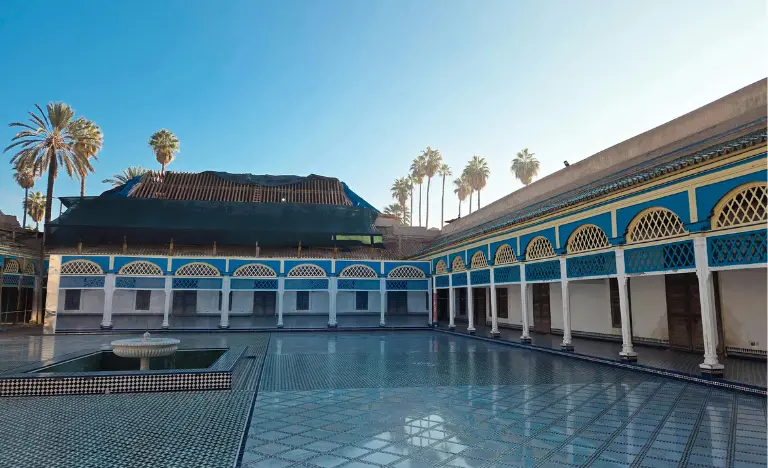
Built in the late 19th century for Si Moussa, Grand Vizier of the Sultan, Bahia Palace is one of the finest examples of Moroccan and Andalusian architecture in existence. Its name means “brilliance” and it earns it.
Tucked within these narrow streets is one of the city’s most celebrated monuments, known for its ornate ceilings and peaceful gardens. Don’t miss our detailed Bahia Palace visitor tips for the best times to visit and what to look out for.
The palace took 14 years to complete, with master craftsmen brought from Fez and Tetouan to create the intricate carved stucco, painted cedar ceilings, and zellige tile work. The grand courtyard alone is worth the visit.
Our full guide to Bahia Palace Marrakech: History, Architecture & Visitor Tips covering everything from the best time to visit to the stories behind each room.
Practical info:
- Entrance: approximately 70 MAD
- Best time: early morning (8:30–17:00) before tour groups arrive
- Allow 45 to 60 minutes
4- Ben Youssef Medersa
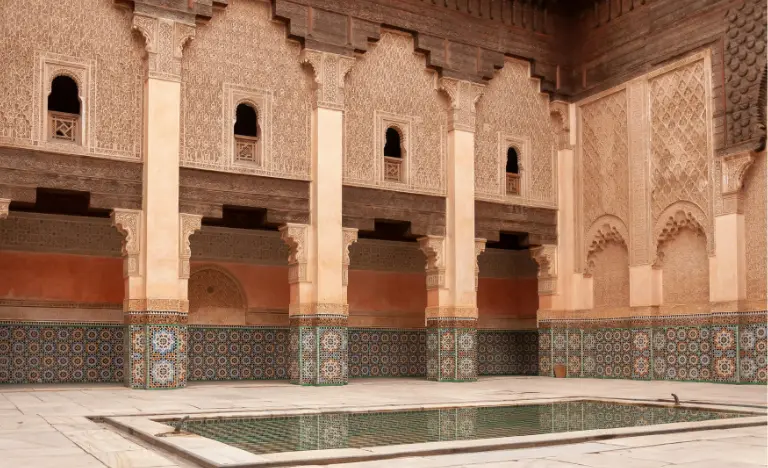
Just north of the souks, this 14th-century Quranic school is arguably the most architecturally stunning building in the Medina. At its peak, it housed over 900 students in tiny cells that still line the upper floors.
The central courtyard is a masterpiece of geometric zellige, carved stucco, and cedar wood every surface covered in detail. It was closed for restoration for several years and recently reopened. Don’t miss it.
5- The Tanneries (Chouara)
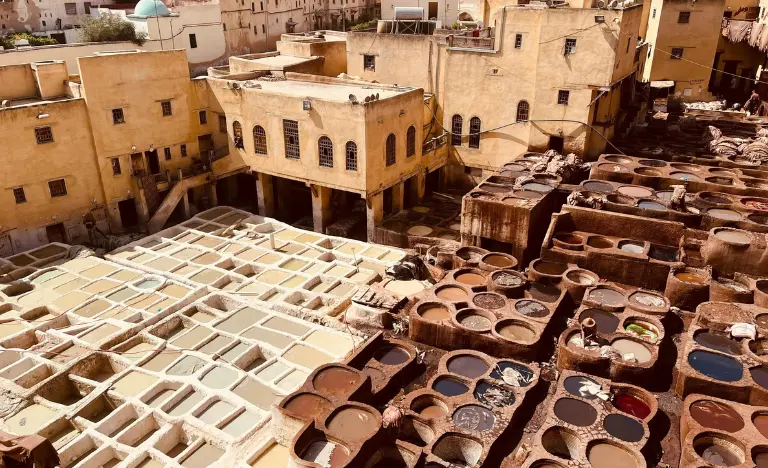
The leather tanneries of Marrakech are one of the most photographed sights in Morocco and one of the most misunderstood. The large vats of dye and the workers treading hides by foot look unchanged since the 11th century because, largely, they are.
How to visit without getting scammed:
- You’ll be invited into leather shops with rooftop terraces overlooking the tanneries this is the standard way to see them, and it’s fine
- You are under no obligation to buy anything
- The shop owner will likely offer you mint leaves to mask the smell, accept them
- The best light for photos is in the morning
6- The Mellah (Jewish Quarter)
Often overlooked by visitors rushing between the main sights, the Mellah is one of the oldest Jewish quarters in Morocco, established in the 16th century. Today, very few Jewish families remain, but the architectural traces are everywhere, the distinctive wrought-iron balconies, the synagogues, the covered spice market.
It’s quieter, less touristy, and one of the most historically layered parts of the Medina.

How to Navigate the Medina Without Getting Lost
Beyond the well-trodden paths, the medina also conceals quieter corners that most tourists walk right past. If you enjoy discovering the unexpected, our list of Marrakech’s hidden gems points you toward some of these lesser-known treasures.
The layout: The Medina was designed to be confusing. Narrow derbs (dead-end alleys) branch off without warning, streets change names every hundred meters, and the same corner looks different from every direction. This wasn’t an accident, it was a medieval security feature.
For a broader look at navigating Marrakech beyond the Medina, read our complete guide to exploring Marrakech.
Practical navigation tips:
– Use Google Maps with limits. Google Maps works well for the main streets but often fails in the smaller derbs. Download an offline map before you go. Waze is a good alternative for the narrower alleyways.
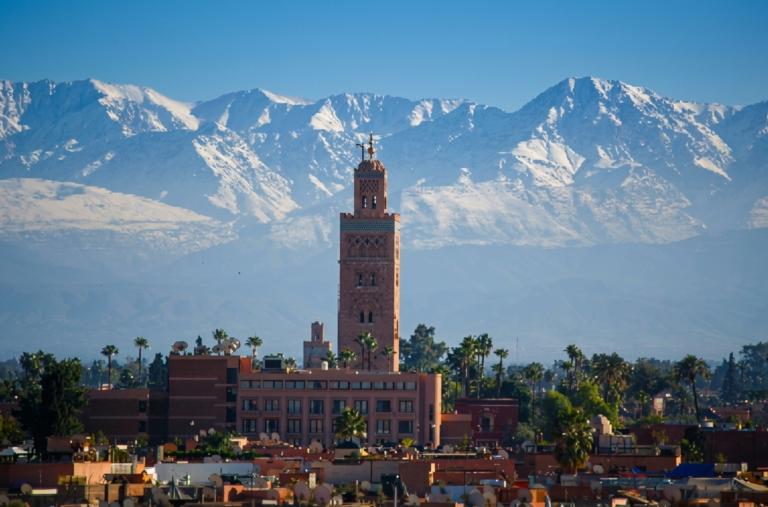
– Use minarets as landmarks. The Koutoubia Mosque minaret visible from most of southern Medina is the best fixed reference point. If you can see it, you can orient yourself.
– Use the gates (babs). The Medina has 19 historic gates. Knowing which gate you entered through and roughly how long you walked gives you a mental anchor.
– The motorbike rule. Motorbikes share the streets with pedestrians and they don’t slow down. Always walk close to the walls, on the right side of any alleyway. You’ll hear them coming, but give yourself room.
– Unofficial guides. Young men who offer to “show you the way” are not always scammers, but many will lead you to a carpet shop and expect a commission. A polite but firm “no thank you, I know where I’m going” works. If you want a guide, book a private guide before you arrive.
Where to Eat and Drink in the Marrakech Medina
1- Street Food You Must Try
The Medina is one of the best places in Morocco to eat if you know where to look and what to order.
| Food | Where to find it | Price (approx.) |
|---|---|---|
| Fresh orange juice | Jemaa el-Fna stalls | 3–5 MAD |
| Msemen (flaky flatbread with honey) | Any morning bakery | 2–5 MAD |
| Harira (tomato and lentil soup) | Jemaa el-Fna, afternoon onwards | 10–15 MAD |
| Bissara (fava bean soup with cumin) | Street stalls near Bab Doukkala | 5–10 MAD |
| Snails (Ghlal) | Jemaa el-Fna night stalls | 5–10 MAD |
| Kefta tagine | Restaurants in the souk lanes | 60–100 MAD |
For a more authentic experience, join a traditional Marrakech food tour and discover hidden local spots, street food, and Moroccan flavors beyond the usual tourist routes.
2- The Jemaa el-Fna Night Food Stalls
At night, the square’s center fills with numbered food stalls, a chaotic, steaming row of grills, tagines, and vendors shouting menus in five languages. It’s an experience worth having at least once.
Practical advice: All stalls serve essentially the same food at similar prices. Agree on the price before sitting down. If a vendor quotes you something that sounds too high, it probably is, move to the next stall. Stalls numbered in the middle of the row (away from the edges) tend to be slightly less aggressive.

Where to Drink Mint Tea
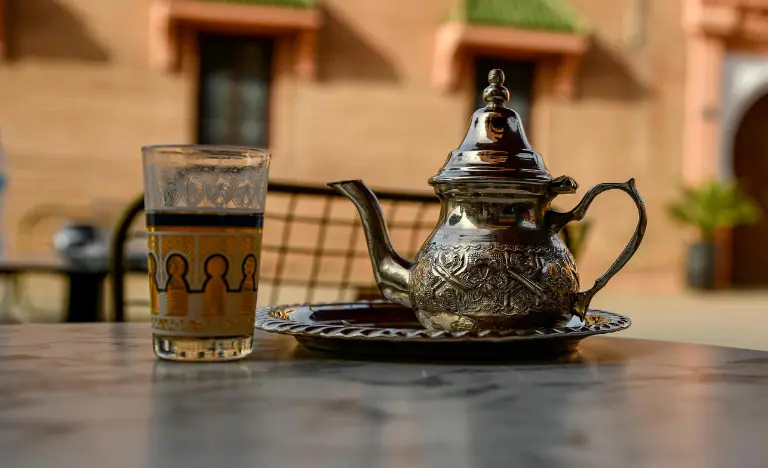
Mint tea in Morocco is not just a drink , it’s a ritual, a gesture of hospitality, and the currency of every negotiation. A properly made Moroccan mint tea (atay) is poured from height to create a foam, sweetened generously, and served in small glasses.
Where to drink it authentically:
- In any small café away from the main square (10–15 MAD)
- At your riad, most offer a complimentary glass on arrival
- At a local spice merchant’s shop, where it’s offered as a gesture before any conversation about buying
Avoid the rooftop tourist cafés around Jemaa el-Fna that charge 50–80 MAD for the same glass. The view may be worth it once, but the tea isn’t.
Restaurant Recommendations
For a sit-down meal, the best options in the Medina fall into two categories: the atmospheric rooftop restaurants overlooking Jemaa el-Fna (better for the experience than the food) and the hidden local restaurants tucked into the residential alleys (better for both).
Ask your guide where the locals eat. It’s never on a main street, never has an English menu displayed outside, and almost always has a handwritten sign above a narrow doorway. It’s worth finding.
Practical Tips for Visiting the Marrakech Medina
Best Time to Visit
Time of day:
- 7am–9am — the quietest the Medina ever gets. Bakers are working, markets are setting up, almost no tourists. The best time for photography and for getting a feel for real local life.
- 10am–1pm — the souks come alive, the Medina is busy but manageable
- 3pm–6pm — peak heat in summer, but also when craftsmen are most active
- After 8pm — Jemaa el-Fna at its best, food stalls in full swing
Time of year:
- March–May and September–November are the ideal seasons,warm but not scorching, fewer crowds than summer
- June–August can reach 40°C, plan outdoor visits for very early morning
- December–February is cool and quiet, the Medina at its most local, fewest tourists
What to Wear
The Medina is a living, working city where people pray, raise families, and go about daily life. Dress accordingly.
- Both men and women: Cover shoulders and knees
- Women: A light scarf is useful for entering mosques or more conservative areas not mandatory everywhere, but respectful
- Shoes: Comfortable walking shoes are essential. The streets are uneven cobblestone. Sandals work; heels don’t.
- Avoid: Revealing clothing, especially around the mosques and the Mellah

Bargaining in the Souks
Bargaining is expected and part of the culture, but there are unwritten rules.
- Start at roughly 40–50% of the asking price for most souvenir items
- Never start bargaining if you’re not genuinely interested in buying it’s considered rude to walk away after a price is agreed
- Smile, stay relaxed aggression and frustration rarely get you a better price
- Fixed-price shops exist look for signs saying “prix fixe” no bargaining expected there
- The best prices are usually found away from the main souk arteries, in the quieter lanes where less tourist traffic means less markup
Safety in the Medina
The Marrakech Medina is safe. Petty crime exists as it does in any dense urban tourist area but violent crime against tourists is rare.
What to actually watch out for:
- Pickpocketing in crowded areas like Jemaa el-Fna at night keep your phone in a front pocket
- Unofficial guides who lead you to commission-paying shops
- Price inflation at stalls immediately adjacent to the main square
- Motorbikes always the most present physical danger
For a detailed breakdown of safety across Marrakech the Medina and beyond
For a detailed breakdown of safety across Marrakech the Medina and beyond read our guide: Is Marrakech Safe for Tourists?
Why a Private Guide Changes Everything
The Marrakech Medina has 9,000 alleyways. Most visitors with two or three days see the same four streets, the same two palaces, and eat at the same handful of restaurants that appear on the first page of every travel blog.
A licensed local guide doesn’t just show you more they show you differently. They know which tannery terrace gives the best angle at what time of day. They know the hidden courtyard behind the unmarked door in the Mouassine quarter.
They know the 80-year-old spice merchant who will tell you more about Marrakech history in 20 minutes than any guidebook.
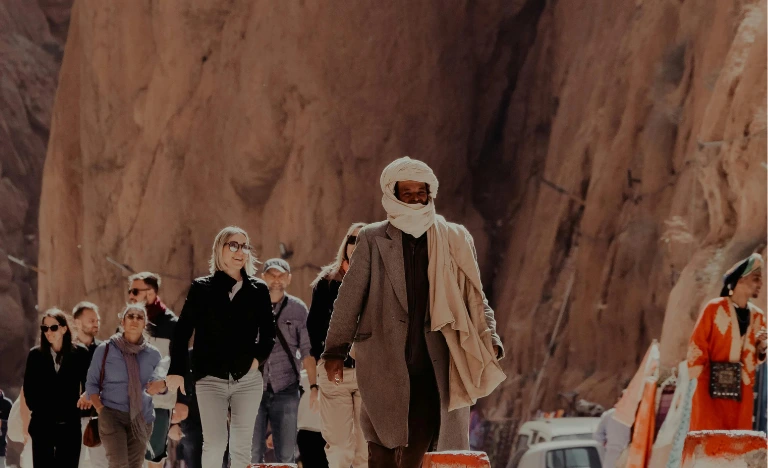
Our private Marrakech city Tour is a 3-hour walking experience through the old city with a licensed local guide covering the souks, the major monuments, hidden corners, and authentic food stops, entirely adapted to your pace and interests.
If you’re planning a longer stay, our 3 Days in Marrakech itinerary maps out a complete trip Medina, day trips, and beyond.
Conclusion
Exploring the Marrakech Medina is less about checking monuments off a list and more about experiencing the rhythm, history, and energy of the city itself.
From the souks and palaces to hidden alleys and local food stalls, every corner reveals a different side of Marrakech. Arrive curious, take your time, and the Medina becomes one of the most unforgettable experiences in Morocco.
Frequently Asked Questions
The souks generally open around 9am and close between 8–9pm. Most shops close on Friday afternoons for prayer. The Medina itself never closes; it’s a living city but the commercial activity slows significantly after 9pm and before 9am.
A comfortable day in the Medina costs between 300–500 MAD per person covering entrance fees (Bahia Palace ~70 MAD, Ben Youssef Medersa ~70 MAD), street food, mint tea, and a sit-down lunch. Budget more if you plan to shop in the souks.
Yes, the Medina is best explored entirely on foot. No cars are allowed in most of the inner streets. Comfortable walking shoes are essential as the streets are uneven cobblestone. The main sights are within a 20–30 minute walk of Jemaa el-Fna.
Darija (Moroccan Arabic) is the primary language, with Tamazight (Berber) widely spoken too. French is universally understood in tourist areas. English is increasingly common, especially among younger shopkeepers and guides. A few words of Arabic “shukran” (thank you), “la shukran” (no thank you), “bshhal” (how much?) go a long way.
Ready to explore the Marrakech Medina with an expert local guide? Talk to our team and we’ll design the perfect experience around your schedule and interests.