3 Day Sahara Tour from Marrakech: My Merzouga Itinerary, Day by Day
💡 Quick Answer If you’re wondering what three days to Merzouga really look like, here’s the short version:
|
I was born in Marrakech, and I have driven the road to Merzouga more times than I can count, usually with someone in the back asking “are we nearly there?” somewhere past Ouarzazate. So I’ll be straight with you from the first line: a 3 day Sahara tour from Marrakech is a lot of road for one night in the dunes.
It is also, for most of the people I take there, the part of Morocco they still talk about years later.
On This Page
- Is a 3 Day Sahara Tour from Marrakech Worth It?
- The Itinerary, Day by Day
- The Camel Trek and Desert Camp: What Really Happens
- Stops Most Tours Rush Past
- Who This Trip Suits (and Who Should Skip It)
- Mistakes I See First Timers Make
- Conclusion
Is a 3 Day Sahara Tour from Marrakech Worth It?
Yes, if you want the tall dunes of Erg Chebbi and can accept one very long drive home. Three days is the minimum I’d recommend for Merzouga, which sits about 560 km from Marrakech ; a fourth day makes the return far more relaxed.
Erg Chebbi is the place for big, orange dunes, with some reaching around 150 m. The closer Zagora option is a genuine desert experience, but its dunes are much smaller. For the full difference, see our comparison of Merzouga vs Zagora.
If you’re heading north afterwards, you can also finish in Fes instead, as explained in our guide to Marrakech to Fes via the Sahara.
And for an overview of every route and trip length we run, see our Sahara desert tour from Marrakech.
The Itinerary, Day by Day
This is the route I drive most often. Times are approximate and shift with the season, the weather on the pass, and how long you want to stay at each stop, which is exactly the point of doing it privately.
| Day | Route | Main stops | Night |
|---|---|---|---|
| Day 1 | Marrakech → Dades Valley | Tizi n’Tichka, Aït Ben Haddou, Ouarzazate, Skoura, Kelaat M’Gouna | Guesthouse, Dades Valley |
| Day 2 | Dades Valley → Merzouga | Dades viewpoints, Tinghir, Todra Gorge, Tafilalt, Rissani | Desert camp, Erg Chebbi |
| Day 3 | Merzouga → Marrakech | Sunrise on the dunes, then the same road back over the Atlas | Back in Marrakech |
Day 1: Marrakech to the Dades Valley
- 7:30 am, leaving Marrakech. We head southeast on the N9. Within an hour the plain gives way to the first High Atlas villages, walnut trees and terraced fields.
- Mid morning, Tizi n’Tichka. The sign at the top of the pass says 2,260 m, and it’s often described as the highest major road pass in North Africa , and between November and March it can get snow. We stop for photos and a mint tea, then start down the southern side, where the landscape turns red and dry very quickly.
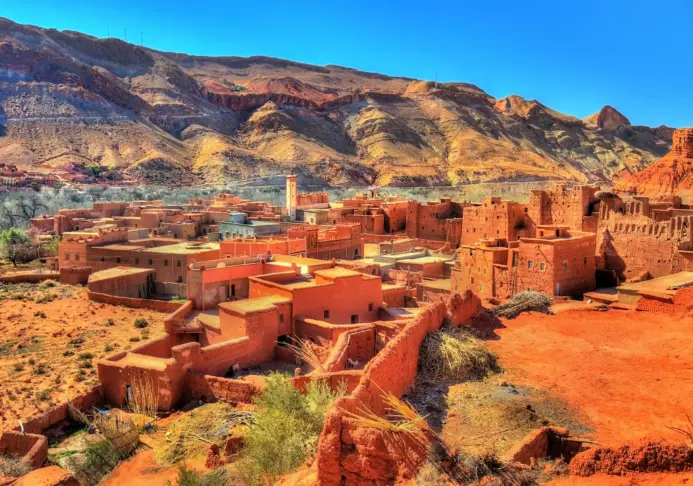
- Late morning, Aït Ben Haddou. This fortified earthen village on the Ounila River is the stop everyone recognizes from films. It has been on the UNESCO list since 1987, and UNESCO’s description of the Ksar of Aït Ben Haddou notes that none of its oldest standing buildings appear to be earlier than the 17th century. I give people at least an hour here to walk up to the old granary at the top. If you want more time and background, I’ve written a full guide to visiting Aït Ben Haddou.
- Lunch. A simple tagine near the ksar. Nothing fancy, and that’s fine.
- Afternoon, Ouarzazate to Kelaat M’Gouna. We pass through Ouarzazate, then Skoura’s palm grove and the Valley of Roses around Kelaat M’Gouna. In spring you can smell the rose harvest from the car window.
- Around 6 pm, Dades Valley. We sleep in a guesthouse in the valley, under rust colored cliffs. Dinner, an early night, done.
Day 2: Todra Gorge, the Tafilalt and the Dunes
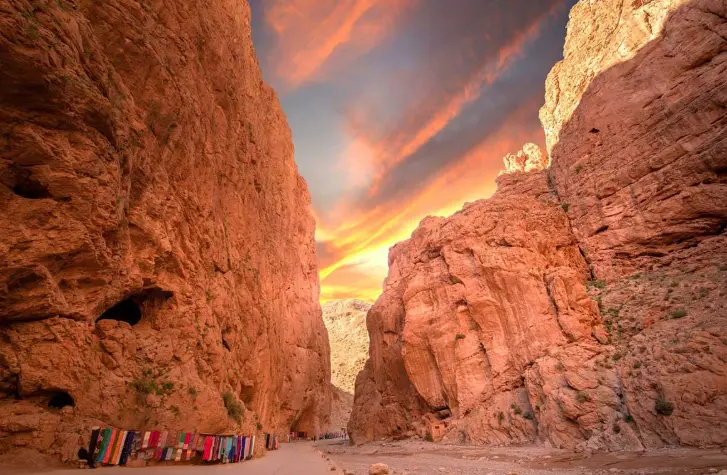
- 8:30 am, Dades viewpoints. Before leaving, we drive up to see the famous switchback road winding up the gorge. A short detour, great photos.
- Mid morning, Tinghir and Todra Gorge. From the town of Tinghir, the road climbs along a long palm oasis until the canyon closes in. At its narrowest, the two walls are only about 10 m apart. We park and walk the last stretch on foot, which is the only way to feel how tall those walls really are.
- Early afternoon, the Tafilalt. Heading east, we enter the Tafilalt, Morocco’s largest Saharan oasis. Rissani sits near the ruins of Sijilmassa, which, according to Britannica’s entry on the Tafilalt oasis, was founded in 757 on the caravan route between the Niger River and Tangier. When I tell people that gold and salt once passed through here on camels, the flat, quiet landscape suddenly makes sense.
- Lunch, madfouna. This is the region’s stuffed flatbread, filled with spiced meat, onions and herbs, baked until the crust is crisp. People call it “Berber pizza.” I call it the best lunch of the whole trip.
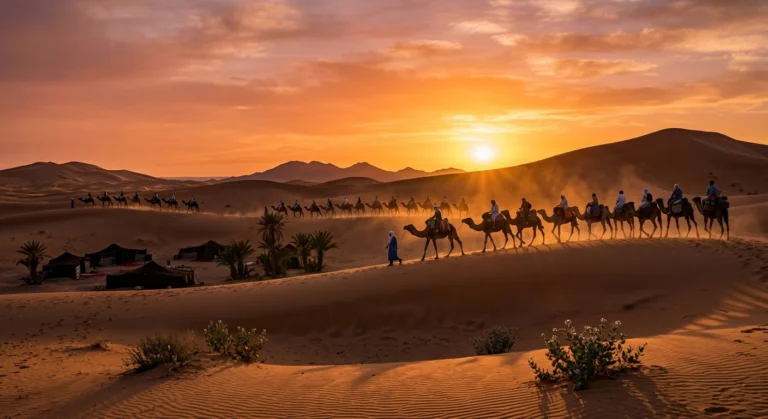
- Around 5 pm, the edge of Erg Chebbi. We leave the car, you pack a small overnight bag, and you ride into the dunes as the light turns orange. Dinner and the night are at camp.
Day 3: Sunrise and the Long Road Home
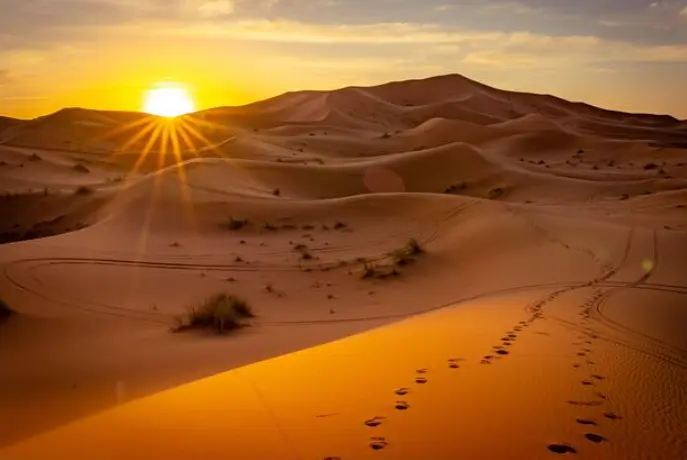
Before dawn. Someone from the camp wakes you up. Climb the nearest high dune, sit down, and wait. This is the moment the whole trip is built around.
After sunrise. Camel ride back, shower, breakfast at a guesthouse near Merzouga.
Around 9 am, departure . Now comes the honest part. The drive back to Marrakech is the same distance you covered over two days, done in one. We break it up with a lunch stop and short leg stretches, and most people doze for a good part of it. You’ll be back at your riad in the evening, tired and very happy you went.
| 💡 LOCAL TIP FROM AYOUB “On Day 3, eat a proper breakfast even if you’re not hungry at 7 am, and grab the seat on the side facing the mountains once we cross back over the pass. Better still, ask me to split the return with a night in Aït Ben Haddou or Ouarzazate. It turns a ten hour day into two relaxed ones, and it’s the single change that most improves this trip.” |
The Camel Trek and Desert Camp: What Really Happens
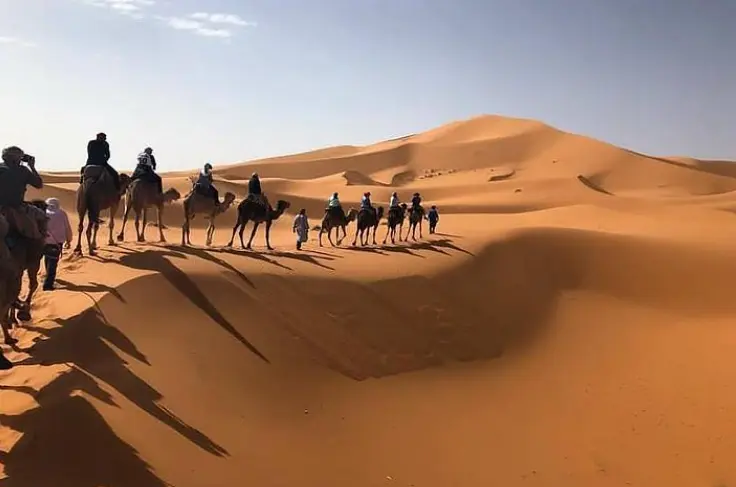
The camel ride is gentle. Your dromedary kneels, you climb on, and when it stands up, lean back and hold the handle. The walk to camp usually takes around an hour, with the guide leading on foot.
Camps range from simple tents with shared bathrooms to comfortable options with proper beds and private showers. Dinner is usually tagine, followed by drums around the fire and a sky full of stars.
If you prefer not to ride a camel, most camps can also be reached by 4×4 without missing the sunset or the desert atmosphere. For the best viewpoints and dunes to explore, see our Erg Chebbi dunes guide
Stops Most Tours Rush Past
Big group tours follow a tight schedule, so these are the places that usually get skipped or reduced to a view from the bus.
The Tinghir Palm Oasis on Foot
Most tours drive straight to the gorge. I like to walk twenty minutes through the palm gardens below the old village first. You see irrigation channels, families working small plots, and kids on donkeys. It’s everyday life, not a show.
Khamlia and Its Gnawa Music
South of Merzouga, the small village of Khamlia is known for its Gnawa musicians, whose music traces back to West African roots. Sitting with them over tea for half an hour gives you a very different side of the desert than the camp drums.
Rissani’s Old Market
Rissani has a lively traditional market where locals buy dates, spices, livestock and household goods. If our timing lines up with a market day, I always plan a stop. Ask me when we plan the trip and I’ll build the schedule around it.
Who This Trip Suits (and Who Should Skip It)
Couples love the camp night, especially in a private tent. Many of my couples add a few slow days afterward, and if that sounds like you, our Marrakech retreat is built exactly for recovering from 1,100 km of road.
Families do well with children old enough to handle long car days, roughly eight and up in my experience. Younger kids love the dunes but struggle with Day 3.
Photographers get dramatic light at Aït Ben Haddou, in Todra Gorge and on the dunes, but should ask for extra time at each stop, which is only realistic on a private trip.
Solo travelers often prefer private tours for flexibility, even if shared ones cost less.
Who should skip it? Anyone who truly hates long drives or gets badly carsick on mountain roads. The road over the Atlas has many tight bends. In that case, do four days or more, or choose something closer.
If you want to compare the route and what the trip includes, see our Sahara desert tour from Marrakech
Mistakes I See First Timers Make
| Mistake | Why It Matters | Fix |
|---|---|---|
| Booking a “2 day Sahara” trip expecting Merzouga | Most go to Zagora, with much smaller dunes | Check the route before booking; Merzouga needs at least 3 days |
| Packing only summer clothes | Desert nights get cold, especially in winter | Bring a warm layer and read my what to pack for the Sahara in Morocco list |
| Traveling in July or August without a plan | Daytime heat in the desert is intense | Choose spring or autumn, or plan early starts and late afternoon activities |
| Carrying no cash | Small cafés, tips and village purchases are often cash only | Take out dirhams in Ouarzazate or Tinghir before the desert |
| Bringing a large suitcase to camp | Camels carry little, and space in tents is limited | Pack a small overnight bag and leave the rest in the car |
| Booking the cheapest shared tour | Crowded vehicles and fixed shopping stops eat your time | Compare what’s included, not just the price |
Conclusion
A 3 day Sahara tour from Marrakech is a fast-paced trip: early mornings, long drives and one night in the desert. But it gives you a chance to experience the High Atlas, Aït Ben Haddou, the Dades Valley and, finally, the dunes of Erg Chebbi.
If you can add a fourth day, the journey becomes much more relaxed. If three days is all you have, it can still work well as long as you know what to expect and have a well-planned route with the right stops along the way.
Frequently Asked Questions
About 560 km, which is roughly 9 hours of driving without stops, and more once you add breaks . That’s why a 3 day tour splits the way out over two days and does the return in one.
Yes, if you want the big dunes of Erg Chebbi and accept a long drive back on Day 3. If you can, add a fourth day to make the return more relaxed.
Light, loose, long clothing for the day, a scarf for sun and sand, closed shoes, and a warm layer for the night. Camp nights can be surprisingly cold outside summer.
Yes. Bring dirhams for tips, drinks, snacks and small purchases in villages. Withdraw money in a larger town such as Ouarzazate or Tinghir before reaching the desert.